2013年11月15日金曜日

4. Utopia


4. Utopia


       We cannot escape from various pains as long as we live in this world. Physical pains and mental distress are always close by. When anxiety weighs heavily on our mind or we are overwhelmed by grief, we found solace in imagining another new world without any pain. That is a fantasy of heaven. Such longing appears almost all mythologies and legends. There are a lot of idyllic imagination from ancient times that people enjoy great happiness and pleasure in unexplored island or uncharted land which is guarded from being discovered by the barrier of nature or the saving grace of god. For example, Arcadia in grease, Shangri-La in James Hilton’s novel, El Dorado, Avalon in the romance of King Arthur, Atlantis, Agartha, Zipangu in The Travels of Marco Polo, etc. Such places are called “utopia”.


              Illustration for the 1516 first edition of Utopia

    “Utopia” was coined by Thomas More (1478 – 1535).  He connected grease words “ou” and “topos”. The former means “no” and the latter means “place”. However most people think utopia as a peaceful paradise, utopia originally means an inhuman regimented society in More’s book “Utopia”. He satirized the then European society in the book.


        In the West, ancient people thought that there was paradise somewhere in mountain and there was peaceful island from beyond the sea. And after the expedition by Alexander the Great, because of the influence of many strange things from the East a lot of utopian fiction travel journal was written by many European writers. The thought that there was somewhere paradise definitely different from this painful society didn’t go out unless Europeans were cornered into inland and lost the connection with the ocean by advancement of Muslims. Imagining opposite situation from now became the way of social criticism and satire, political principles, constructional plans, and literature.


      Depiction of the tale on a painting from the Long Corridor, Summer Palace, Beijing

         In the East there are a lot of story about utopia. But they are different from those of the West. The characteristics of the stories about utopia in the East are that people can go there without difficulty by an accident. One of the most famous Chinese utopian stories is The Peach Blossom Spring written by Tao Yuanming (365 – 427). The story is that a fisher went up to a river and he found the hall to a peaceful village. The inhabitants told they had escaped from war. He enjoyed staying there for few days. After he returned his village, he tried to go there again but he couldn’t. Why he couldn’t go there again is paradise is not in this world but in our recesses of the mind. Because he seek utopia outside, he got more and more lost the way.   


         Thomas More’s utopia is not fantastic society but socialist nations as the result of effort by common people. On the other hand, in The Peach Blossom Spring people gave up the realization of ideal society.


 reference: ユートピアの幻想(川端香男里)
        桃源郷 中国の楽園思想(川合康三)   


2013年11月1日金曜日

3. Levitation


3. Levitation


In this time when flying the speed of sound is common, it may be ridiculous to say human have a capacity of floating in the air without any vehicles and tools. But we have a lot of stories about the phenomenon that people floated in the air by the power of something spiritual. Though there is no field researching this phenomenon strictly, this phenomenon levitation is very interesting even now. Ancient people who have the world view quite different from the current rationalism accepted, studied and even used the mysteries power that causes levitation.


                      Ignatius of Loyola
  It seems that there is a close connection between levitation and religion. There are many examples about it. Ignatius of Loyola was always suspended in the air thirty centimeter to the ground for his meditation. All believers who floated in the air feel a kind of religious ecstasy. Therefore it can be thought levitation is secondary phenomena caused by leaving the mind from the body and reality. Of course this phenomenon is not limited to the case of Christian. But Christian thought levitation by pagan magic or itself as a satanic phenomenon. So they prohibited their believers from studying about levitation.  


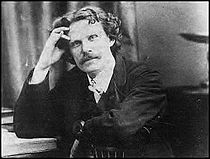
                     D.D.Home


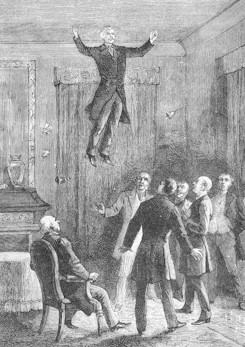
                              levitation at Ward Cheney's house


If levitation happens without any physics causes, it is natural to think levitation can happen by psychokinesis. Spiritualists succeeded to Christians. One of the most famous spiritualistic medium, Daniel Douglas Home (1833 - 1886), he was willing to show a lot of people including royals and celebrities his spiritual power such as shaking a house, floating a table, causing smell or chill, playing accordion without touching and floating himself in the air. In July 1871, he performed a spiritual agency at Ward Cheney's housein London. He got trance and floated in the air while sitting down. He went out to the outside through the window and came in through another window. The room was third flour and eighty five feet to the ground. Thereafter he tried and succeeded again and again in front of a large number of people including scientists. Sir William Crookes, British scientist (1832 - 1919), started to research Home’s strange power. Crookes was these days one of the most famous scientist because of finding thallium and inventing a new vacuum tube. But he couldn’t find any trick and explanation of that phenomenon. And Home had never been charged as a fraud in public. Thereafter many psychical researchers tried to explain Home’s phenomenon. But there is no good explanation even now. 
                                                 
Listening to such strange stories, we cannot help feeling the weakness of present science and that we live in between rationalism and experimentalism.

 reference: 英国心霊主義の台頭(Janet Oppenheim  和田 芳久 訳
       フェノメナ (J. ミッチェル、R. リカード、 村田 薫


2013年10月17日木曜日

2. Doppelgangers


   If you met someone who exactly resembles you or met yourself, you would turn white with fear and could say nothing. You may have heard the word doppelganger. Doppelganger means double walker in German. From the above, doppelganger is used as the word referring to the phenomenon that the third party see yourself at the place where you were not, a man see another himself or the supernatural being that is almost identical to a man living. And generally seeing own doppelganger is sign of his unfortunate or death.


fig.1

    It may be unbelievable that there is a lot of great man who met his doppelganger from ancient times. For example, Aristotle saw his counterpart walking ahead of him. Goethe, age twenty-one, passed himself wearing a gorgeous cloth on the road, eight years later when he went down the same road he found that he wore the cloth that he saw. So he met his future figure. Japanese writer Ryunosuke Akutagawa told he saw his doppelganger and he was especially attracted the story about doppelganger; Illness of Shadow, written in Edo Era. Many writers, such as Hoffmann, Poe, Dostoevsky, Chamisso, Wild, Maupassant and Musset picked up this phenomenon in their books. The noteworthy fact is that most of them were artists having some kind of mental problems.


                                         fig.2
     In psychology, seeing alter ego is called heautoscopy. Heautoscopy is defined as the phenomenon that own mind is projected onto the outside. In psychosomatic medicine, the first time when heautoscopy was picked up is in 1488 by Heinrich Kramer and Jacob Sprenger. They told they saw own alter ego lying by the side of him. However the systematic study started after the 19th century. Heautoscopy can appear not only mental patient but also ordinary person when he is tired or he is going to sleep. Fear, sadness, sleepiness or strictly self-hate can cause ordinary person to see their alter ego. Except for the occasion that heautoscopy appears to ordinary person, heautoscopy is caused by the factor such as the influence of alcohol or some kind of drugs, a high fever, mental disease or having an epileptic seizure. By the way we can give a dream as the thing being similar to heautoscopy. We see own appearance as if the man who can be seen original in a dream. And the feeling that an infant first see himself in a mirror is said to resemble heautoscopy.


     Because heautoscopy resembles a type of pain associated with an amputated limb, called phantom limb, we can give an explanation heautoscopy with an idea of body image. Each of us has an image of the whole body in their heart. It is not mere perception but a pile of the sort of the perceptions and the image of spatial relationship between each of the parts. It is cold body image. So heautoscopy can be explained as the result of the projectile from own body image by some kind of causes.

  reference 泉鏡花 芸術と病理(吉村博任)
        東西不思議物語(澁澤龍彦) 


2013年10月10日木曜日

1. The tengu -天狗-


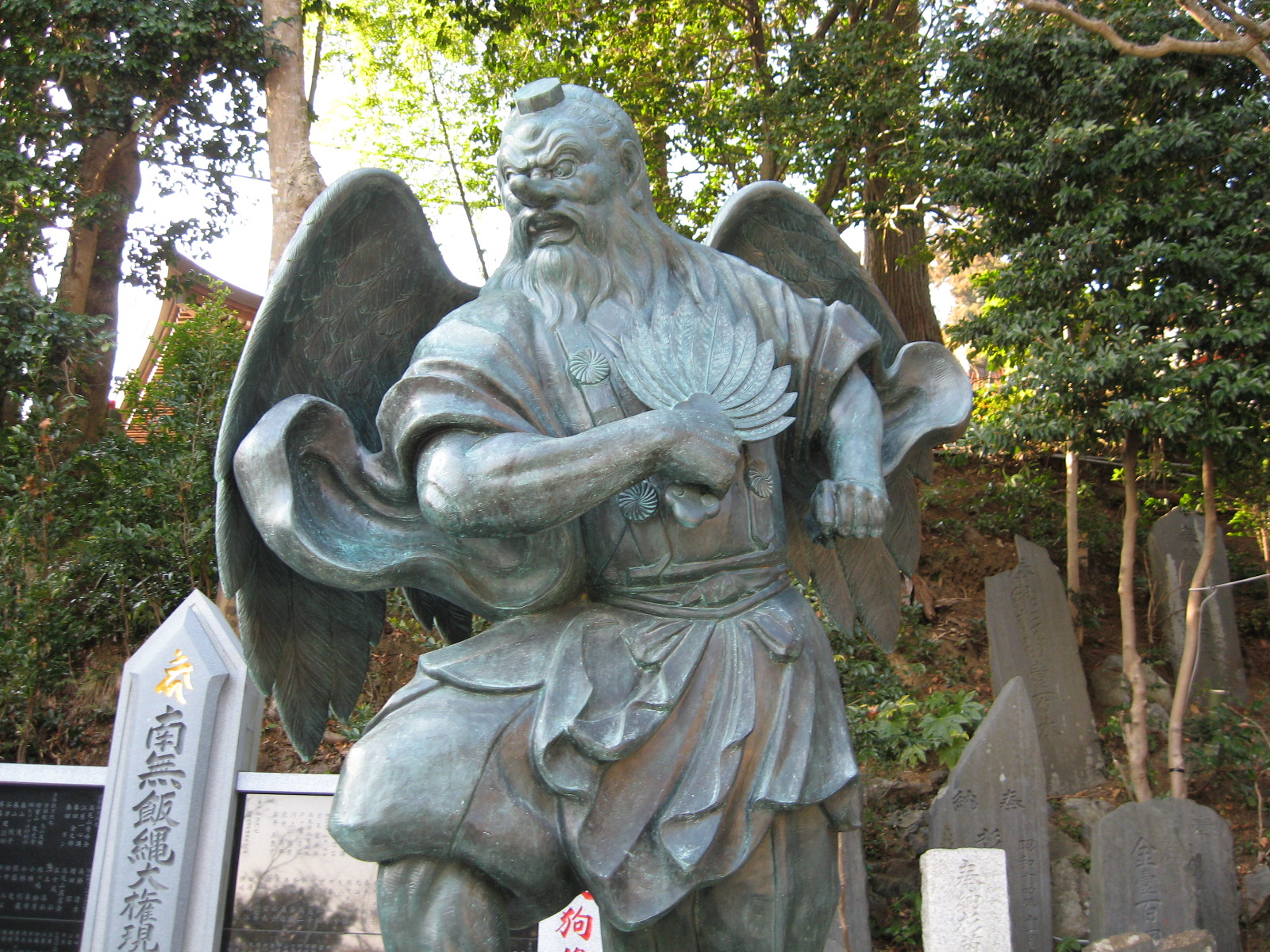
The tengu is one of the most famous monsters in Japan. They have red face and long nose. They fly and sometimes kidnap a child being lost in the mountain. But the first time the tengu is completely different from the image that is believed today.


The first time the tengu appeared in Japanese history is 638 A.D when Emperor-Jomei ruled. A big comet appeared above the capital growling like a thunder. Then priest-Min who had just back to Japan from China said “That is the tengu, not meteor! Their cry is like a thunder.” The tengu writes “天狗”. “” means the sky and “” means a fox. The ancient Chinese people could consider the trail which comet left to a fox’s tail. In brief, the tengu came from Chinese legend and that is a sing of disaster. But thereafter the tengu didn’t appear in Japanese history for more than 200 years.


The tengu appear in the middle of Heian Period again. Around this time the relationship the tengu and a mountain ascetic began to be strong. First, the tengu was treated like a fairly as the cause of the echo. And they came to use magic that they change man to women, women to man. Moreover they came to curse the nobles who tried to build the house in the mountain of the tengu. In this way the teng penetrated as a popular belief. However the tengu was not more popular than the ogre, the vengeful spirit, dragons and foxes that deceive the people.


The Japanese Warrior Society started, the tengu gained the power. They love the war because they are originally sign of disaster. There are a lot of tales which were written in this age about the tengu and samurai. In fact, around this time, mountain ascetic’s status was established. More and more people began to be a mountain ascetic. They must want to be like the tengu using magical powers and being liberty. So it is natural that many legends about the tengu rose among the people. In this way, the tengu became a one of the most famous monsters in Japan.


Unfortunately, today a lot of people don’t believe the tengu. I don’t say that we should warship the tengu, but it is sad that so many people live in the city that the relationship between people and nature, such as forest and mountain, is being weak. If you go to the mountain having a legend about the tengu, you will find the reason why many people believed the tengu.


reference   天狗考(知切光蔵)
                    天狗の研究(知切光蔵)